AAI Solutions Presents at Insurance Innovators Summit 2025
[Transcript]
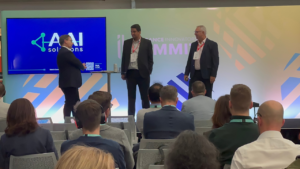
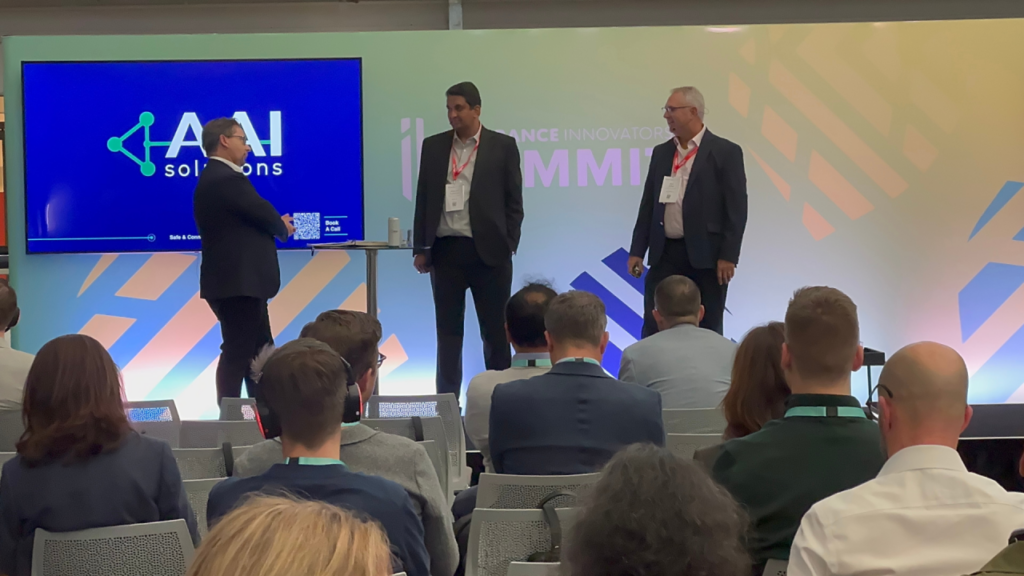
Good afternoon, everyone. I’m Roger Duffield CPCU, ARM, Executive Vice President at AAI Solutions, and I’m joined by my colleague and development partner, Deviprasad Thrivikraman from Zentis.
What you just saw was an ordinary claims moment — but powered by AI.
A driver, a phone, a simple message, and an intelligent system that instantly knows what to do next.
That short exchange captures what Agentic AI makes possible in insurance: human interactions made effortless by intelligent automation working safely behind the scenes.
Let’s start with a story that and one in claims can relate to.
It’s Monday morning. Claims from the weekend start flooding in — emails, PDFs, voicemails, web forms, even photos texted from the side of the road. Each one looks different, comes from a different source, and half of them are missing the same basic details.
Someone in the intake team opens their inbox and just stares for a second, deciding where to even begin. Another employee is copying information from one system to another, trying to match a policy number to the right customer. Someone else is fielding a phone call because the claimant isn’t sure if they already filed online.
It’s chaos — and it’s completely normal.
One of our clients described it perfectly. They said, ‘We spend more time collecting claims than resolving them.’
And that’s the reality across the industry. Data comes in from everywhere. None of it talks to each other. Every channel adds friction, errors, and delay.
This is the world we walked into, the First Notice of Loss process that every insurer depends on but no one has truly fixed.
Now, that story isn’t new.
Over the years, the industry has thrown everything at this problem. OCR to read documents. RPA to move data. Chatbots to answer customers faster. And more recently, AI pilots to extract, classify, or summarize.
But each one worked in isolation. OCR could read a field but not understand what it meant. RPA could follow a rule but not know when the rule no longer applied. Chatbots could chat — until the conversation changed. And generative models? Brilliant at writing, not so great at compliance.
So, instead of one big problem, we ended up with ten smaller ones — each running in a different place, owned by a different team, producing a different result.
One claims director told us, ‘We’ve automated everything we can, but we still don’t trust the results.’
That’s the reality today is fragmented tools, disconnected data, and processes that can’t keep up.
The answer isn’t tearing down those systems. It’s giving them something smarter to work with. A foundation that connects, collaborates, and adapts safely — right inside your existing environment.
That’s what led us to develop our solution, intelligence that fits in, learns fast, and works across your systems instead of replacing them.
So, what exactly is Agentic AI?
Let’s start with what it’s not. It’s not another bot or script. It’s not a single model dropped into a workflow.
Think of Agentic AI as a team of digital colleagues — each one with a clear role, working together under your supervision.
One agent reads and understands documents. Another checks data against your policy rules. A third validates what’s missing or inconsistent. And a fourth decides where the claim should go next.
They communicate, they coordinate, and they learn — all safely inside the boundaries you define.
The difference is orchestration. Where RPA follows fixed instructions, and traditional AI just predicts or generates, Agentic AI brings reasoning and context into the loop.
It’s intelligence that senses, decides, and acts — but always with guardrails, transparency, and human control.
If RPA is a logic tree, and generative AI is a creative spark, Agentic AI is where those two come together — logic with understanding, creativity with discipline.
And the best part? It doesn’t replace your systems. It sits alongside them — reading, writing, and communicating through the same channels your teams already use.
It’s like adding a layer of intelligent collaboration that never sleeps, never forgets, and never goes off script.
Now let’s take this out of theory and into the real world.
One of our clients faced a challenge that every insurer here has dealt with — fragmented claim submissions.
They had claims arriving by email, through web forms, over the phone, and even via messaging apps. Every channel looked different, used different formats, and none of it lined up.
The result was predictable: delays, manual rekeying, and inconsistent data quality.
So, we deployed a team of agents designed specifically for First Notice of Loss, or FNOL.
They listen across all those channels, read and interpret incoming information, validate the policy, and automatically populate the claim form — all within seconds.
This isn’t a static model or a brittle automation. These agents learn, adapt, and collaborate inside a controlled environment, with governance and human oversight.
Devi, can you walk us through how this Agentic AI framework makes that possible — and why it works where so many other AI pilots have failed?
Sure, Roger.
It really comes down to three things: control, context, and collaboration.
Most AI pilots fail because they’re built as isolated experiments, a single model solving a single task, with little governance around it.
Our approach is different. Our solution combines multiple specialized agents, each accountable for a specific function, all operating inside a controlled environment where every decision is traceable.
That combination of intelligence and structure is what makes it sustainable…and safe
And that’s what we mean when we say AI empowering humans with super speed and strength not replacing people, but extending what they can do.
AI doesn’t fail for lack of intelligence. It fails for lack of governance.
In fact, about 95% of AI pilots in insurance never make it to production. And when you look at why, the reasons are surprisingly consistent: • No explainability. • No real-time visibility. • No measurable governance.
So when something breaks, no one knows what happened, or who’s accountable.
Controlled Agentic AI fixes that by embedding safety into every layer of the system.
Explainability means every decision an agent makes, every data point, every action, is logged with context. You can always ask, ‘Why did this happen?’ and get a clear, auditable answer.
Observability means you can see your agents working in real time. You know what’s happening, where, and why, just like you’d monitor any other part of your operation.
Guardrails set the limits. If something looks off, the system flags it, escalates it, or stops it entirely before it becomes an issue.
And at the center of it all is the Human-in-the-Loop. Your experts stay in command. The AI assists, but it doesn’t replace. It learns from your team, and your team stays in control.
That’s the key difference: our AI isn’t a black box. It’s a supervised network of intelligent agents that operate within clearly defined rules and oversight.
You don’t lose control, rather you gain clarity.
The results speak for themselves.
Claims handled with Agentic AI closed 40 percent faster. Audit coverage expanded by three times, without adding headcount. And manual effort dropped by nearly 60 percent across intake and validation.
But the biggest impact wasn’t speed — it was confidence.
Every claim now moves through a system that’s explainable, observable, and fully auditable. That means decisions are faster and safer.
Agentic AI moves insurers from pilots that impress to systems that deliver.
And we don’t stop at First Notice of Loss.
The same Agentic AI framework is transforming other critical functions across the insurance lifecycle.
Take audit. Every insurer struggles to audit enough files to catch errors, fraud, and leakage — there simply isn’t enough time or staff.
With Agentic AI, audit coverage expands automatically. Specialized audit agents review claims data, compare it against policy terms, flag anomalies, and prepare summaries for human reviewers — all with full traceability.
What used to take weeks can now happen overnight, without changing a single core system.
Or underwriting. Instead of analysts searching through scattered data, underwriting agents gather information, verify it across sources, and present a clear, consistent package for human review.
These use cases are powered by our insuranceOS platform — a connected environment where every agent operates under the same governance, observability, and human oversight you’ve already seen.
And all of it runs safely within your existing ecosystem, powered by Zentis engineering at its core.
That’s how Agentic AI scales: not by replacing systems, but by weaving intelligence through the ones you already trust. [end demo]
That entire call was handled by an AI agent — in real time — using live data from the insurer’s system. It validated identity, confirmed policy information, updated the record, and created a full transcript for compliance review, in under a minute.
No app download, no queue, and every step documented.
The same Agentic AI that processes documents can now speak, listen, and reason…safely.
So far, we’ve shown how Agentic AI handles text, documents, and data. But what happens when the next customer doesn’t send an email or a form — they pick up the phone?
The same technology that reads and writes can also listen and speak — safely, with context and compliance built in.
Let’s see what that sounds like.
something like this…
AI Agent: “Good afternoon. This is the claims assistant calling on behalf of your insurer. Before we continue, may I confirm your policy number ending in 3-9-7 and your date of birth?”
Customer: “Yes, that’s right.”
AI Agent: “Thank you. I’d like to verify the contact details we have on file. Our record shows your mailing address as 221 Oak Ridge Drive, Boca Raton, Florida. Is that correct?”
Customer: “That’s correct.”
AI Agent: Perfect. I’ll mark that as verified. We’ll text you a summary of your claim and your adjuster’s contact details shortly. Thank you for confirming, and I hope the rest of your day goes smoothly.”
The future isn’t coming. It’s already here.
You’ve just seen Agentic AI handle claims intake, validate data, and even confirm customer information live over the phone connecting with the systems insurers already use.
This is practical, governed AI, transparent, explainable, and ready for real operations.
It’s how we move from pilots that impress to ecosystems that deliver measurable results.
On behalf of AAI Solutions and Zentis, thank you for joining us and we look forward to speaking with you.