
Trusted AI for Learning: Why Grounded, Explainable AI Matters in Education
AI is already in the classroom.
The bigger question is whether schools can trust the AI they are using.
Students are using generative AI for schoolwork. Teachers are experimenting with AI tools. Institutions are evaluating AI-powered tutoring, assessment, content creation, and analytics.
But there is a fundamental difference between an AI system that can generate a convincing answer and one that can explain why that answer is appropriate for this learner, in this classroom, at this moment.
That distinction matters.
Because education isn’t a domain where “probably right” is good enough.
AI for learning needs to be grounded in what the institution actually knows.
It needs to understand the learner’s history, the curriculum being taught, the assessment data available, and the institutional rules governing how that information can be used.
Most importantly, it needs to be trusted, explainable, auditable, and governed.
The Trust Problem With Generative AI in Education
The adoption of generative AI has moved faster than institutional governance.
Research from the College Board, as referenced in the source material for this article, found that 84% of high school students reported using generative AI tools for schoolwork in October 2025, up from 79% just months earlier.
The usage isn’t limited to experimentation.
Students are using AI to brainstorm, revise essays, research sources, and complete assignments.
ChatGPT is particularly prominent, with 69% of high school students reporting that they use it directly for assignments and homework.
That creates an important reality for education leaders:
AI is already being used for learning, whether institutions have fully prepared for it or not.
The question is no longer simply whether students should use AI.
The more important question is:
Is that AI operating inside an environment the institution can understand and govern, or outside one it cannot see?

What Does “Trusted AI” Actually Mean?
Trusted AI isn’t simply AI that produces accurate-looking answers.
For education, trusted AI needs several layers of protection.
1. Grounded
The AI should reason from authoritative information rather than relying solely on general model knowledge.
2. Explainable
Users should be able to understand why the system made a recommendation or took an action.
3. Auditable
Institutions should be able to review what happened, what information was used, and what actions were taken.
4. Governed
The institution, not the AI, sets permissions, policies, and boundaries.
5. Contextual
The system should understand the learner, curriculum, and institutional environment.
Together, these principles create something more valuable than an AI chatbot.
They create trusted intelligence for learning.
Why Grounding Matters in AI for Learning
One of the biggest challenges with general-purpose generative AI is hallucination.
A hallucination occurs when an AI system generates false or misleading information while presenting it as fact.
In education, that creates an obvious problem.
Imagine a student asking an AI tutor about a concept from their biology curriculum.
The answer might sound authoritative. It might even be mostly correct.
But if it contradicts the curriculum being taught, or introduces information that isn’t supported by the institution’s approved materials, the student is learning from an unreliable source.
The problem isn’t just accuracy. It’s contextual accuracy.
An answer can be factually reasonable and still be wrong for the learning situation.
That is why AI for learning should be grounded in authoritative sources such as:
Institutional curriculum
Approved learning content
Assessment information
Learner history
Institutional policies
System-of-record data
The goal isn’t to make AI know everything. The goal is to make AI know what matters here.
From Generative AI to Grounded AI
There is an important distinction between asking a general-purpose AI model:
“Explain mitosis.”
and asking a grounded learning system:
“Explain mitosis to this student using the curriculum being taught in this classroom, based on what this learner already understands.”
The second question requires context.
It requires the system to know:
- Who is the learner?
- What are they learning?
- What have they already learned?
- Where are they struggling?
- What does the curriculum say?
- What is the educator trying to achieve?
That is where AI learning systems become fundamentally different from standalone AI tools.
Persistent Memory: The Missing Context Layer
Trust isn’t only about the information an AI uses. It’s also about whether the system remembers the right information over time.
Consider a learner who struggles with a particular concept. A standalone AI chatbot may answer the student’s question today.
Tomorrow, it may have no idea what happened today. A connected AI learning system can build continuity.
It can understand:
What the learner previously studied
Which concepts they struggled with
Which explanations worked
What assessments they completed
What the teacher has already tried
This creates persistent learning memory.
And persistent memory allows AI to move from answering questions to supporting a learning journey.
Governance Should Be Built In, not Added Later
Responsible AI cannot be an afterthought.
If an AI system handles student information, institutions need to determine:
- Who can see what?
- Who can change what?
- What can the AI recommend?
- What can the AI actually do?
- What needs human approval?
This is particularly important when AI moves beyond generating content and begins interacting with institutional systems.
An AI tutor may support a student.
An AI teaching assistant may help a teacher.
An institutional AI agent may surface risks or recommend interventions.
The greater the system’s role, the greater the need for governance.
That’s why governance should be part of the architecture from the beginning.

AI Should Amplify Educator Judgment
Trust also depends on maintaining the human role.
AI can surface a learning gap.
The teacher decides what to do about it.
AI can recommend an intervention.
The educator decides whether it is appropriate.
AI can generate a lesson activity.
The teacher determines whether it fits the classroom.
This distinction is critical.
The AI provides intelligence. The educator provides judgment.
That is what responsible AI for learning should look like.

How learningOS Is Built for Trusted AI
This is where AAI Solutions’ learningOS provides a practical example of what trusted AI for learning can look like.
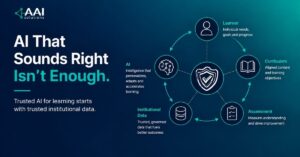
learningOS is designed around a closed loop of institutional intelligence:
Learner history + Curriculum + System of record + Institutional rules → AI intelligence
Instead of generating answers solely from general knowledge, the system is designed to reason from the information that matters within the institution’s learning environment.
That enables:
Grounded Recommendations
AI recommendations can be informed by the learner’s actual context.
Persistent Memory
Learning context can carry forward across interactions.
Role-Based Access
Permissions are determined by institutional roles and policies.
Explainable Intelligence
Recommendations should be understandable rather than appearing as unexplained outputs.
Auditable Actions
AI-driven actions should be reviewable within the governed environment.
This is the difference between adding AI to education and building an AI system for education.
Explore how learningOS brings connected, governed intelligence to education and learning environments.
What Should Schools Ask Before Adopting AI?
Before purchasing another AI tool, education leaders should ask:
Does it use trusted institutional data?
If the answer is no, where does its information come from?
Does it maintain context?
Can it understand the learner beyond a single interaction?
Can we explain its recommendations?
If not, how can educators confidently act on them?
Can we audit its actions?
Institutions need visibility into what AI does.
Can we control permissions?
AI should operate within institutional boundaries.
Does it support educators?
AI should strengthen human expertise rather than remove it.
Does it integrate with existing systems?
Another isolated tool may simply increase fragmentation.
The Future of AI for Learning Is Trusted Intelligence
AI adoption in education is not slowing down. The opportunity now is to move beyond experimentation. Schools need AI that understands context.
Teachers need AI they can trust.
Students need AI that supports learning rather than simply producing answers.
Institutions need AI that can be governed and audited.
That means the next generation of AI for learning won’t be defined simply by how intelligent a model is.
It will be defined by what the system knows, where that knowledge comes from, what it is allowed to do, and whether people can trust the outcome.
The future isn’t AI that knows everything. It’s AI that knows what matters.
People Also Ask
What is trusted AI in education?
Trusted AI in education is AI that uses reliable information, operates within defined institutional boundaries, provides understandable recommendations, and supports human oversight.
Why does AI need to be grounded in education?
Grounding AI in trusted institutional data helps provide responses that are relevant to the learner, curriculum, and learning environment rather than relying solely on general model knowledge.
What is grounded AI for learning?
Grounded AI for learning uses authoritative sources such as curriculum, learner history, assessments, and institutional data to provide more contextual and reliable AI-supported learning experiences.
How can schools govern AI?
Schools can establish clear policies, permissions, data controls, human oversight, auditing processes, and approved sources for AI systems used in learning environments.
Can AI replace teachers?
AI can automate repetitive work and provide insights, but educators remain essential for judgment, relationships, context, and instructional decisions.
FAQ
What makes AI trustworthy for learning?
AI for learning becomes more trustworthy when it is grounded in reliable institutional data, provides explainable recommendations, operates within defined permissions, and maintains auditability and human oversight.
What is AI hallucination?
An AI hallucination is an inaccurate or misleading output presented by an AI system as though it were factual. In education, hallucinations can undermine student understanding and trust.
Why is persistent memory important for AI learning systems?
Persistent memory allows an AI system to retain relevant learning context over time, supporting more consistent personalization and reducing the need to start each interaction from scratch.
Conclusion
The education sector doesn’t need AI that simply sounds intelligent.
It needs AI that is grounded in what is true, governed by the institution, explainable to educators, and useful to learners.
That’s the foundation of trusted AI for learning.
And as AI moves deeper into classrooms, campuses, and learning environments, trust won’t be a feature. It will be the foundation.
Build AI You Can Trust.
See how AAI Solutions’ learningOS connects institutional data, persistent learning context, and governed AI to support educators and learners.