
AI for Learning Systems: Why Education Needs an Agentic AI OS (Not More Tools)
Artificial intelligence is rapidly transforming education—but results remain inconsistent. While AI for learning promises personalization and efficiency, many institutions still struggle with fragmented tools, disconnected workflows, and rising educator burnout.
The problem isn’t the lack of AI tools. It’s the lack of integration, continuity, and system-level intelligence.
As explored in our guide on AI for learning and personalized education, AI delivers the most impact when it connects the entire learning journey—not when it operates in silos.
The Problem: AI Tool Sprawl Is Breaking Learning Systems

Education and L&D ecosystems today are overloaded with tools.
Thousands of edtech tools used across institutions
Educators switching between dozens of platforms
Disconnected data across systems
Instead of simplifying workflows, this has created cognitive overload and inefficiency.
Teachers and trainers are still spending a significant portion of their time on administrative tasks, coordination, and system-switching—reducing their ability to focus on what matters most: teaching and mentoring.
This fragmentation limits the true potential of AI for learning, because intelligence cannot operate effectively without context.
Teachers and trainers are still spending a significant portion of their time on administrative tasks, coordination, and system-switching—reducing their ability to focus on what matters most: teaching and mentoring.
This fragmentation limits the true potential of AI for learning, because intelligence cannot operate effectively without context.
The Limits of Point Solutions in AI for Learning
Most AI tools today solve isolated problems:
Auto-grading tools
Content generation platforms
Analytics dashboards
While useful, these tools operate independently. They do not:
Share learning context
Track learner progression holistically
Enable continuous improvement
Research shows that standalone analytics tools can influence behavior—but don’t necessarily improve outcomes.
The reason is simple:
👉 Learning is a continuous journey, not a series of disconnected interactions.
Without a unified system, AI cannot deliver meaningful, long-term impact.

Research shows that standalone analytics tools can influence behavior—but don’t necessarily improve outcomes.
The reason is simple:
👉 Learning is a continuous journey, not a series of disconnected interactions.
Without a unified system, AI cannot deliver meaningful, long-term impact.
What Is an Agentic AI Operating System for Learning?
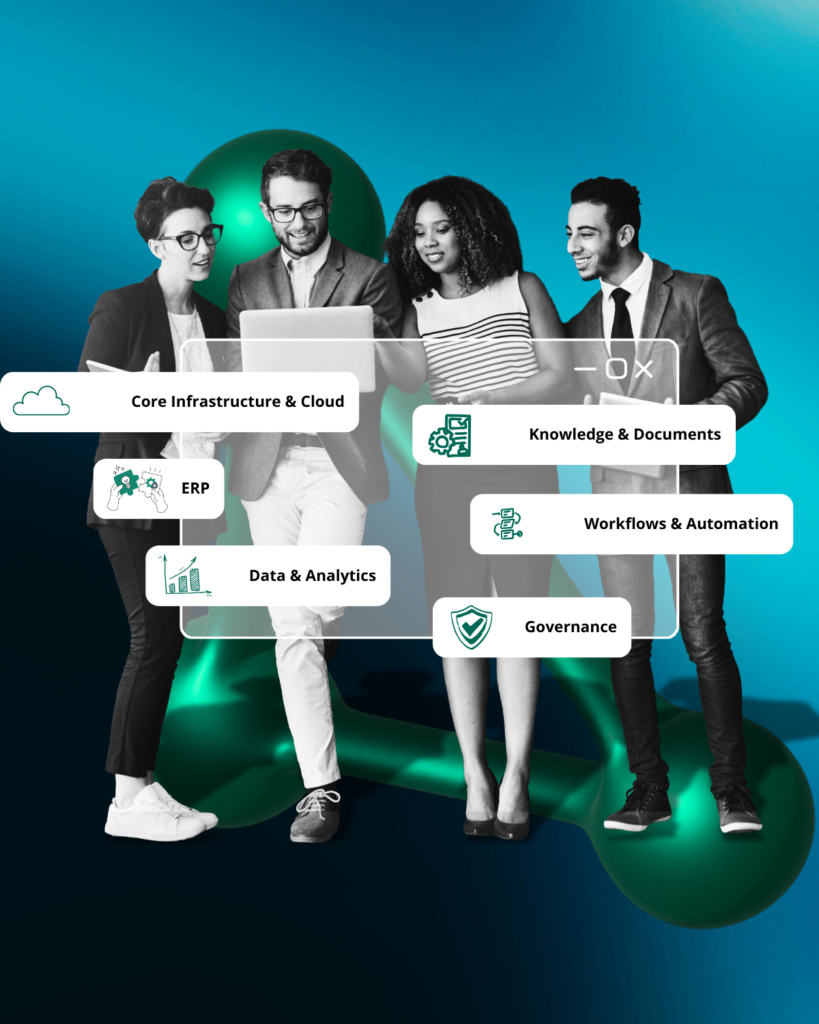
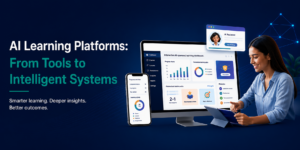
To unlock the full potential of AI for learning, we need to shift from tools to systems.
An Agentic AI Operating System (AI OS) is a unified platform that:
Connects all learning workflows
Maintains persistent learning context
Acts proactively across the learning journey
Instead of reacting to inputs, an agentic system understands, predicts, and guides.
It integrates core functions such as:
Learning design and planning
Content delivery
Assessment and feedback
Communication and collaboration
This creates a continuous intelligence layer across the entire learning ecosystem.
👉 Learn how integrated platforms are shaping the future of AI-driven education. This is where modern AI learning systems move beyond isolated tools.
Benefits of AI Learning Systems
Moving to integrated AI learning systems unlocks real value:
Unified workflows → Less tool switching
Better outcomes → Continuous personalization
Reduced workload → Automation for educators
Real-time insights → Faster intervention
👉 This is the difference between using AI and scaling it.
Why an Agentic AI OS Is Critical for AI for Learning
1. Bringing Time Back to Educators
A large portion of educator time is spent on tasks that can be automated.
An AI OS centralizes these workflows, reducing:
Tool switching
Manual grading
Administrative overhead
This allows educators to focus on:
👉 Teaching
👉 Coaching
👉 Student engagement
Which are the true drivers of learning outcomes.
2. Real-Time Guidance Where It Matters
The most effective use of AI for learning is not replacing educators—but supporting them in real time.
AI can:
Suggest better questions
Identify misconceptions instantly
Recommend next learning steps
This shifts AI from a passive tool to an active teaching assistant.
When AI supports instructors—not just students—learning outcomes improve significantly. This builds on the core principles of AI for learning systems.

3. Continuous Personalization at Scale
Personalization is often discussed, but rarely achieved at scale.
An agentic AI OS enables:
Persistent learner profiles
Continuous progress tracking
Context-aware recommendations
This means learning doesn’t reset at every session—it evolves.
👉 This is the foundation of true AI for learning, where every interaction builds on previous ones.
From Fragmentation to Intelligent Learning Systems
The future of education is not about adding more tools—it’s about connecting them intelligently.
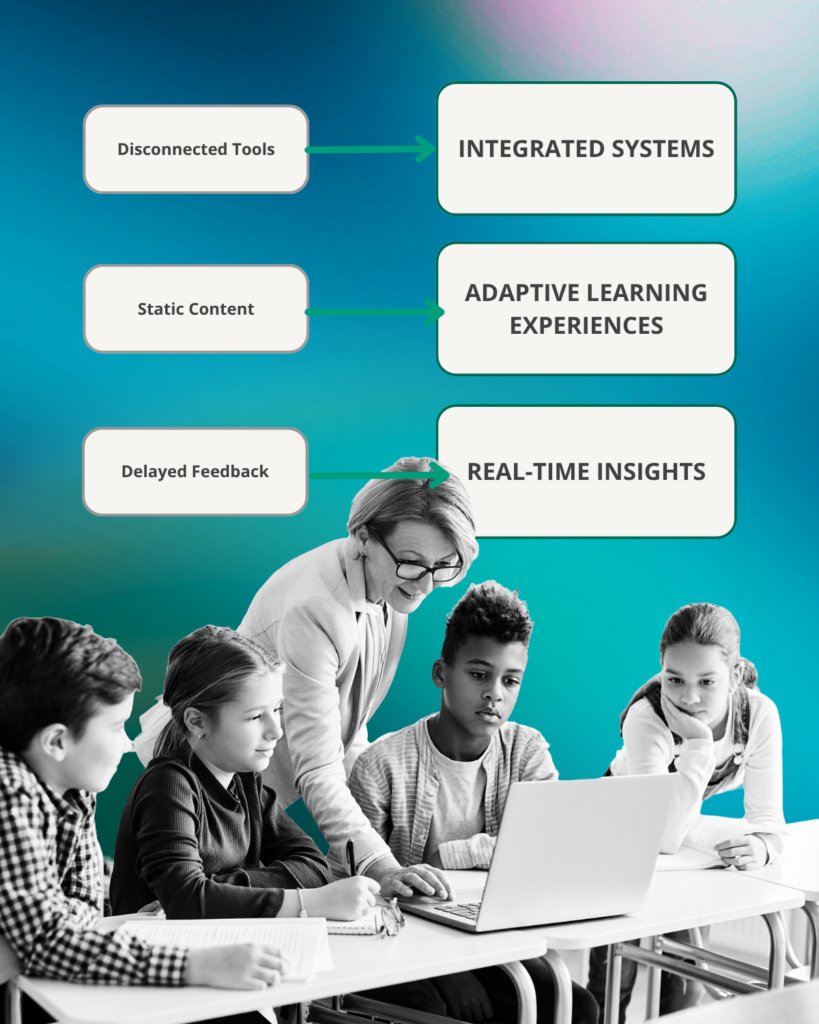
An AI OS transforms learning:
From → To
Disconnected tools → Integrated systems
Static content → Adaptive learning experiences
Delayed feedback → Real-time insights
This shift is critical for institutions aiming to scale AI for learning effectively. Institutions are moving toward integrated AI solutions for learning.
Why This Matters Now: A Market Shift
The education technology landscape is undergoing a major transition.
Learning platforms are evolving beyond content delivery
Institutions are re-evaluating legacy systems
AI is moving from feature to infrastructure
This creates a unique opportunity for AI-native platforms built around orchestration—not add-ons.
Even traditional LMS platforms are moving toward integrated AI capabilities, validating the need for system-level transformation.
How AAI Solutions Enables AI for Learning at Scale

At AAI Solutions, the focus is not on adding another tool—but on building a connected AI ecosystem for learning.
1. Unified Learning Workflows
Plan, deliver, assess, and communicate in a single system—reducing complexity and improving efficiency.
2. Real-Time AI Coaching
Support educators with AI-driven insights and recommendations during instruction—not after.
3. Persistent Learning Memory
Track learning across courses, cohorts, and time—enabling continuous improvement.
4. Flexible and Content-Agnostic
Work seamlessly with existing curricula, tools, and enterprise systems.
This approach ensures that AI for learning is not just implemented—but truly operationalized.
AI for Learning Needs Systems, Not Tools
The future of education will not be defined by how many AI tools we adopt—but by how effectively they work together.
To deliver meaningful outcomes, AI for learning must:
Support educators, not replace them
Connect workflows, not fragment them
Maintain context, not lose it
An agentic AI OS makes this possible.
It turns AI from a collection of features into a cohesive, intelligent system that improves learning outcomes at scale.
FAQ: AI Learning Systems & Agentic AI
What is an AI learning system?
– An AI learning system is a platform that uses artificial intelligence to personalize learning, automate processes, and provide real-time insights for educators and learners.
What is an agentic AI system in education?
– An agentic AI system actively guides and supports learning by making decisions, providing recommendations, and maintaining context across the learning journey.
How is AI for learning different from traditional LMS platforms?
– Traditional LMS platforms focus on content delivery, while AI for learning systems provide personalization, automation, and continuous feedback.
Why do point solutions fail in education?
– Point solutions operate in isolation and lack context, making it difficult to deliver consistent and measurable learning outcomes.
What is the difference between AI tools and AI systems?
– AI tools solve tasks. AI systems connect workflows and enable continuous learning.
Conclusion
AI has already proven its potential in education—but its impact remains limited when applied in isolation.
To truly transform learning, we need systems that:
Connect data
Support educators
Adapt continuously
That’s why the future of AI for learning lies in agentic, integrated platforms—not disconnected tools.
From AI Tools to Intelligent Learning Systems
Most organizations are still experimenting with AI.
The real advantage comes from connecting it across the learning journey.
👉 Explore the AI learning platform today!